Next-Generation Building Management Systems
ARCHITECTURAL EVOLUTION THROUGH CLOUD COMPUTING AND ARTIFICIAL INTELLIGENCE
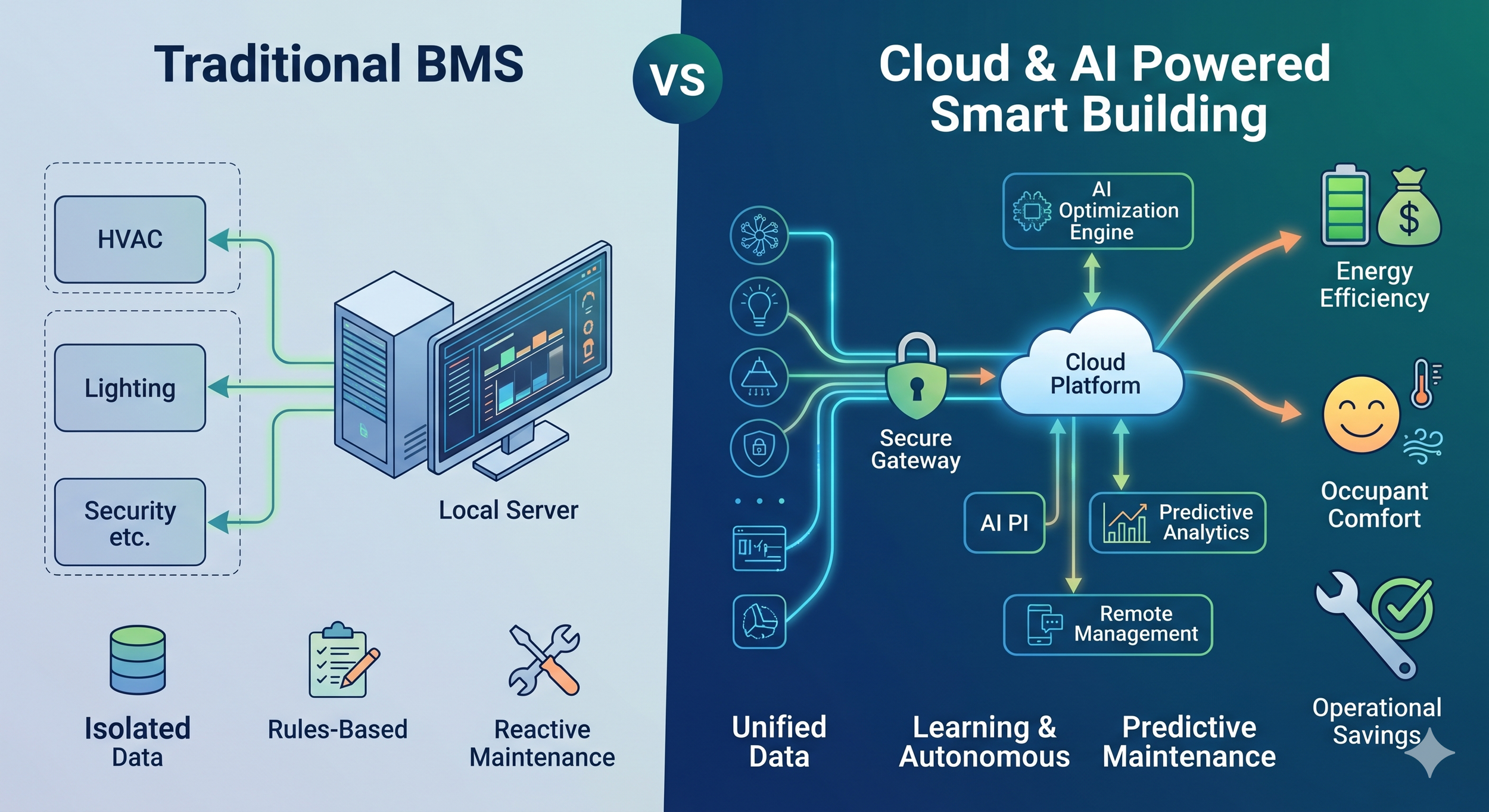
For decades, a Building Management System (BMS)—alternatively referred to as a Building Automation System (BAS)—has functioned as the centralized of commercial and industrial facilities. Its core responsibility centers on monitoring and modulating mechanical, electrical, and electromechanical infrastructure. Historically localized, siloed, and bound by rigid, rules-based logic, the contemporary BMS is undergoing a massive paradigm shift. Driven by the convergence of cloud computing and Artificial Intelligence (AI), modern building management is transitioning from rigid localized automation to predictive, autonomous, and portfolio-wide intelligence.
The Traditional BMS Framework
Traditional building automation relies on a strict, localized hardware-and-software hierarchy. This operational framework is strictly bounded within the physical facility and is typically
structured across three isolated layers: Field Level (Sensors & Actuators): The physical layer consisting of hardware nodes that
measure environmental indicators (e.g., temperature, carbon dioxide levels, relative humidity, pressure, and occupancy metrics) and mechanical actuators (valves, dampers, variable frequency drives, and fans) that execute physical commands.

Empowering the Future: Next-Generation Smart City SCADA Solutions
Unified Operations Centre (UOC) for Urban Infrastructure IT/OT Convergence Modern municipal engineering demands a total collapse of traditional operational silos. Urban landscapes face unprecedented pressure to balance population density, utility scarcity, resource economics, and citizen safety.
Our Unified Operations Centre (UOC) for Smart Cities serves as the digital brain for modern municipalities [cit: 11]. By seamlessly bridging the historically disconnected worlds of Information Technology (IT) and Operational Technology (OT), this solution provides city administrators with a centralized, single pane of glass to ingest, cross-reference, and optimize wide-area urban data fabrics in real time,

Technical Architecture & Core Capabilities
Multi-Protocol Edge Ingestion & Data Fabric Urban environments feature massive, asynchronous data streams from thousands of distinct edge devices.
Our platform normalizes telemetry across a diverse communication landscape, including BACnet,LONWorks, Modbus, MQTT Sparkplug, and OPC UA . Whether managing smart lighting arrays, localized microgrids, environmental sensors, or complex facility mechanical rooms, the data is instantly contextualized into a uniform database
Context-Aware Operations Management Interface (OMI) Step away from static, rigid monitoring screens. Built on situational awareness principles, our OMI dashboards dynamically adapt to the operator’s exact context, device, and permission level . City administrators can switch seamlessly between high-level macro overviews and granular asset diagnostics without cluttering their workspace .
Smart City Automation Layer Standardized Energy Efficiency Gains Across Core Integrated Sectors.3. Deep Third-Party & Engineering Integration The UOC solution isn't just a visualization layer; it is an extensible
Operational orchestrator : Geographical Information Systems (GIS): Contextualizes absolute real-time device tracking straight onto municipal maps . Automated Reporting: Direct data hooks to automated engines like Dream Reports generate compliance
documentation automatically . Advanced Diagnostics: Feeds continuous telemetry pipelines directly into Prism Predictive Analytics to determine time-to-failure windows for municipal infrastructure before downtime occurs